
If you allow children to bring packed lunches it is important that these are healthy and children and families are supported to make healthy choices. This is to ensure that children eating packed lunches are receiving the same nutrition from their food as children eating cooked meals that meet the Startwell Menu Guidelines and the Department of Education Early Years Foundation Stage Nutrition Guidance.
To help settings monitor the quality of children’s packed lunches and promote healthy choices use the following tools and resources:
Packed Lunch Audit
Handouts for Parents
Click the images for the pdfs.



Guidance for Parents
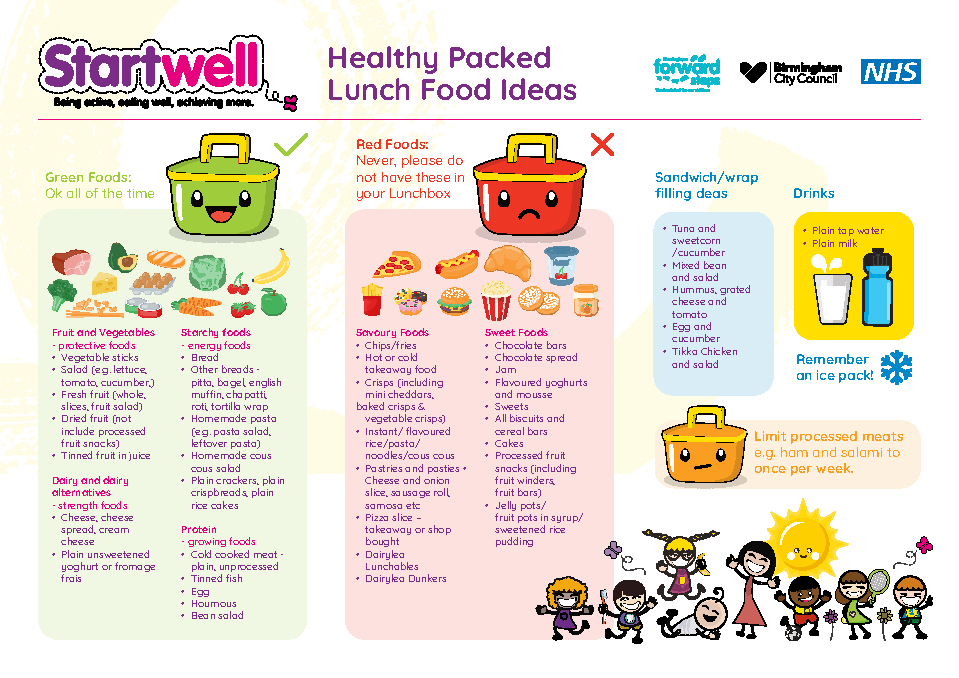
It is important to have clear guidance and ideas for parents to follow. Use the Startwell Packed Lunch Food Ideas sheet to provide parents with ideas of suitable foods to send and those to avoid.
- The Packed Lunch Food Ideas handout splits the foods into red, amber and green groups to help families identify what should go in a packed lunch.
- You can adapt the foods and drinks in the categories to reflect your packed lunch guidance /policy.
- If you allow children to bring packed lunches to your setting this handout should be given to all new parents, it is also good to give out before trips which require the children to take a packed lunch.
- The ideas should also be used in workshops, promotional sessions and as a basis for displays to ensure a consistent message is given.
Packed lunches should include the following types of foods everyday:
- A minimum of 1 portion of fruit or vegetables for vitamins and minerals
- A starchy food for energy and concentration e.g., any bread, wrap, chapatti, pasta, rice, noodles, potatoes. Do not bring flavoured dried rice, pasta, and noodle products e.g., packets and pots of instant noodles, pasta, and rice.
- Meat, fish, eggs or another plant-based source of iron and protein e.g., lentils, kidney beans, chickpeas, hummus for cognitive development.
- Dairy or dairy alternative food e.g., cheese, plain unsweetened yoghurt or fromage frais, for growth of bones and teeth.
- Plain tap water should be provided by the nursery throughout the day and during lunch time.
If parents send foods which are high in fat and/or sugar or which you feel are unsuitable, they should be removed from the packed lunch. If possible and if needed a healthier alternative should be provided and the unsuitable food returned to the parents when they collect their child, with a conversation as to why they are not suitable for packed lunches in your setting.
It can be hard to gauge the correct amount of food to send in a packed lunch and parents may be worried that their child will not be full. Therefore advice on appropriate portion sizes can be helpful and the Startwell portion sizes guidance is available for extra information.
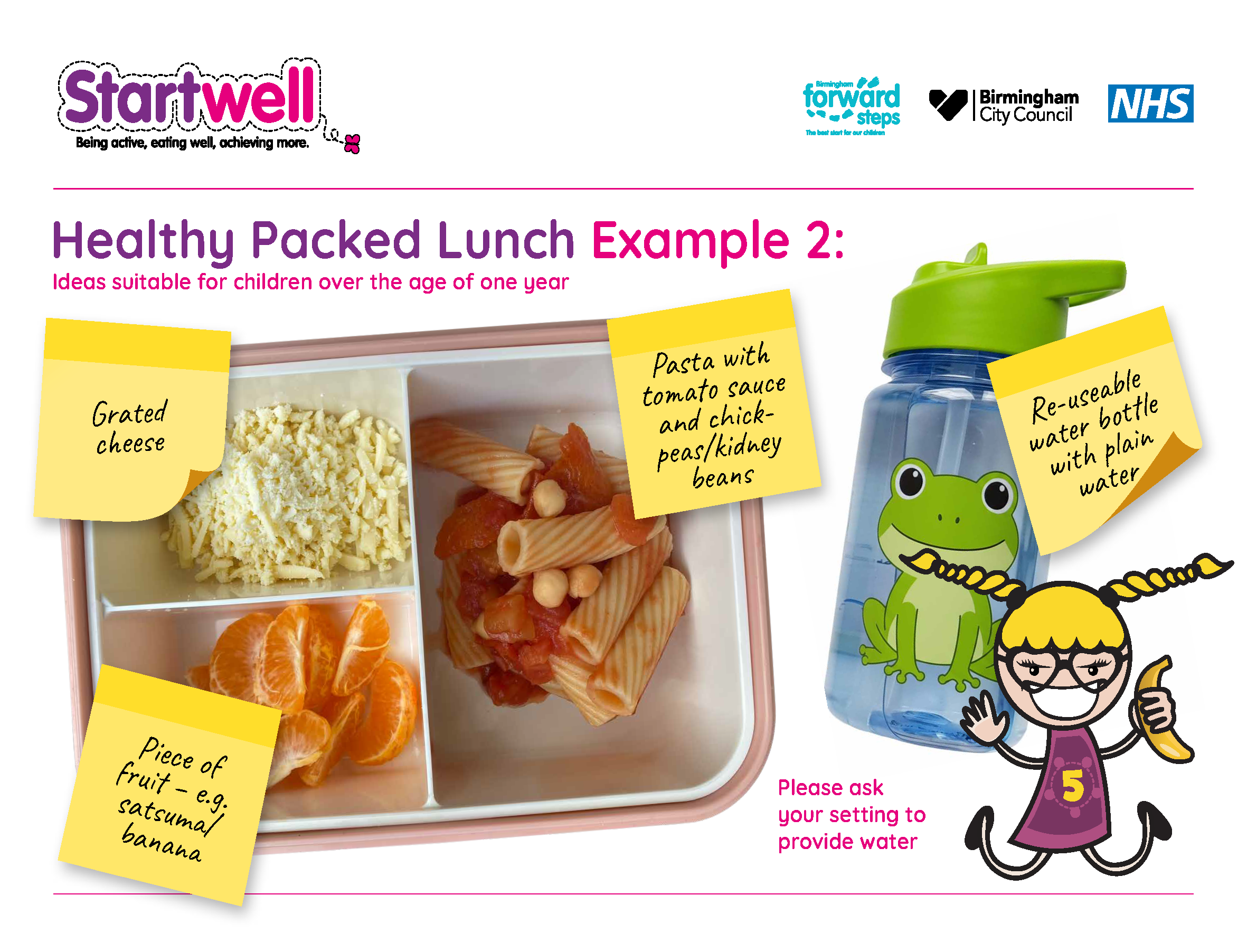
First Steps Nutrition Trust has a very comprehensive guidance document on packed lunches for the early years, “Eating Well: Packed Lunches for 1-4 year olds” which you may find useful to read and share with your parents. We think the following pages may be particularly helpful for providing some good practical tips for your parents:
- Pages 5-6 & 14 – What to include and avoid in packed lunches
- Page 7 – Tips on practical considerations when making a packed lunch
- Pages 16-47 – Pictorial example packed lunches including recipes and tips for each one
Processed Fruit Snacks
There are a lot of processed fruit snacks that are marketed at Early Years children such as fruit winders, stars, peelers, strings, flakes etc. These foods are classified as Ultra Processed Foods and aren’t suitable for Early Years children.
These food products are made from fruit juices and purees and the sugar in them is classed as free sugar, which attack the teeth. A diet high in free sugars is linked to poor oral health and overweight in children. They are not suitable foods to provide as a snack or part of a packed lunch. A healthier and less expensive alternative would be a whole piece of fruit (or cut-up pieces of whole fruit) which contain the vitamins, minerals and fibre that children need.
The picture to the right from ‘Action on sugar’ shows the amount of free sugars in some of the most common processed fruit snacks.
Startwell have created a handout that you can share with parents to highlight why processed fruit snacks are not suitable for our early years children.

Eating with Children
Even though the children may bring a packed lunch it is still important for staff to sit with them and engage in conversations about the foods they have and the Startwell characters. It is even better if the staff can eat some healthy foods or their own healthy packed lunch with the children too as this shows good role modelling and gives more conversation opportunities.
Packed Lunches for Trips
Even though trips are often a special occasion, if a packed lunch is required it should still adhere to the guidelines above. Parents who are not used to providing a packed lunch for their child may need extra support and the ideas sheet to ensure the food they send is appropriate.
Allergies and Food Safety
Any food being brought into the setting should adhere to your food allergy guidance and parents will need to be made aware of this too. It is also important that the children do not share or swap their packed lunch foods to avoid any potential cross contamination of allergens. Parents and carers should clearly label the lunch bag with their child’s name and details of its contents.
Consideration should also be given to food safety, where are the packed lunches being stored? Can you store them in a cool place, out of sunlight and away from heaters? Providers are not required to refrigerate food brought in by children.
For perishable items that need to be kept cool, parents and carers should be encouraged to use an insulated, sealed lunch bag with an ice pack. If ice packs are unavailable, the ‘4-hour rule’ can be applied: food may be kept outside chilled conditions for up to four hours, but this should only happen once during the entire storage period. Where refrigerated storage is unavailable, parents and carers should pack foods that can be safely kept at room temperature. The Food Standards Agency’s advice on Listeria includes examples of ready-to-eat foods that should be eaten within four hours of being removed from the fridge. Providers are also not required to reheat food brought in by children and most settings avoid reheating food due to the extra precautions and requirements around food safety and temperature probing.

Partners

Facebook Posts

New safer sleep guidance for early years settings![]() The Department for Education and The Lullaby Trust have published updated safer sleep guidance for early years providers, which will be included in the EYFS statutory framework from September 2026. The guidance supports safer sleep practices, including placing babies on their backs in a clear, flat, separate sleep space with a firm mattress and no loose items.
The Department for Education and The Lullaby Trust have published updated safer sleep guidance for early years providers, which will be included in the EYFS statutory framework from September 2026. The guidance supports safer sleep practices, including placing babies on their backs in a clear, flat, separate sleep space with a firm mattress and no loose items.
startwellbirmingham.co.uk
Looking for ideas of things you can do in your setting for October? Take a look at our October events blog post where we have linked national events to Startwell messages.
startwellbirmingham.co.uk