Sleep

There is increasing evidence that lack of sleep is linked to childhood obesity.

Good sleep for children is linked to many benefits for their physical and mental health including maintaining a healthy weight. Current evidence recommends that pre-school children should be getting a minimum of 10-11 hours sleep.

Below are two sources of the current evidence based research to help us understand why sleep is important.

Lack of sleep can affect child obesity

A published systematic review showed that children who slept less than the recommended for their age are more at risk of becoming overweight or obese. The journal reviewed 42 studies in total including 7 studies on children in their infancy and 8 studies on early childhood. The journal concluded that educational programs could be used to encourage parents to improve the sleep quality and duration of their children.

Reference – Sleep research society, (2018) Sleep duration and incidence of obesity in infants, children, and adolescents: a systematic review and meta-analysis of prospective studies, Michelle A. Miller1, Marlot Kruisbrink, Joanne Wallace, Chen Ji and Francesco P. Cappuccio.

Guidelines on physical activity, sedentary behaviour and sleep for children under 5 years of age

The World Health Organisation have produced guidelines (2019) on the amount of physical activity, sedentary behaviour and sleep children should have under 5 years of age. The guidelines looked at a 2017 systematic review looking at the relationship between sleep duration and health indicators in the early years. The review concluded that shorter sleep duration was associated with higher obesity levels, poorer emotional regulation, impaired growth, more screen time and higher risk of injuries.

Reference – World Health Organisation (2019) Guidelines on physical activity, sedentary behaviour and sleep for children under 5 years of age https://www.api-play.org/wp-content/uploads/sites/4/2019/08/Play-must-stay-4-pager.pdf

Settings should be encouraging parents to ensure their children get good quality sleep of a suitable length for their age. Bed time routines can be discussed with parents to try and encourage a good sleep patern.

Bedtime Routines:

  • The last hour before bed should be a quiet period. This means avoiding exciting play, physical activity and exciting/frightening television programmes.
  • Ideally all screen time before bed should be limited. This includes tablets, smartphones, TVs and other electronic gadgets as these can affect how easily children get to sleep.
  • Children having a favourite soft toy or blanket that they take to bed each night can be helpful. This can help the child fall asleep especially if they wake in the night.
  • Make sure that the toy or blanket is safe without any ribbons or buttons that could be a choking hazard.

It is important that a bedtime routine is consistent and the bedroom environment is the same every night. The bedroom should be cool, quiet and dark without a TV in the room. A story in the child’s bedroom is a calm and relaxing way to end the bedtime routine. Do not let the bedtime routine be too long, it should be no longer than 60 minutes. Ideally your child should be taken to their cot or bed while they are still awake so that they can learn to fall asleep without you.

Children will get used to their bedtime routine and understand what is expected from them. This will hopefully lead to a good night’s sleep for the child.

For more information on children’s sleep and sleep routine you can advise parents to speak to their health visitor and give them the parent sleep handout.

More information can also be found https://www.nhs.uk/live-well/sleep-and-tiredness/healthy-sleep-tips-for-children/

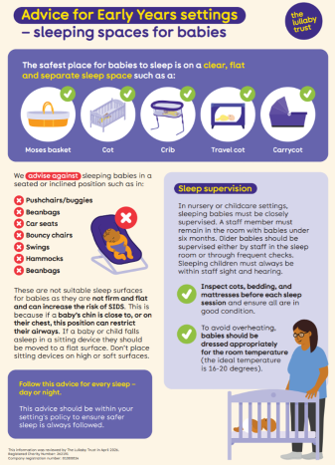
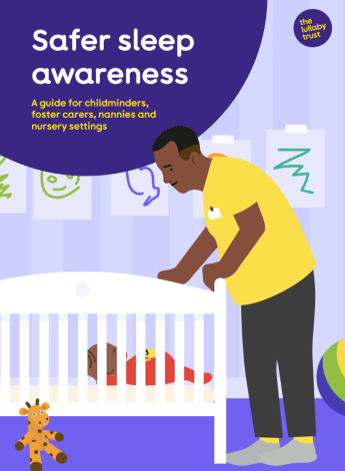
Safer Sleep Guidance for Early Years Settings:

  • The Department for Education (DfE), in collaboration with The Lullaby Trust, has issued updated safer sleep guidance for early education and childcare settings. This guidance will be incorporated into the Early Years Foundation Stage (EYFS) statutory framework from September 2026.
  • The guidance aims to reduce the risk of sudden infant death syndrome (SIDS) in babies under 12 months and sudden unexpected death in childhood (SUDC) in children over 12 months.
  • Early years safer sleep guidance requires babies to sleep on their backs in a clear, flat, separate sleep space, with firm mattresses, no loose items, and close supervision, following Department for Education and Lullaby Trust standards effective from September 2026.