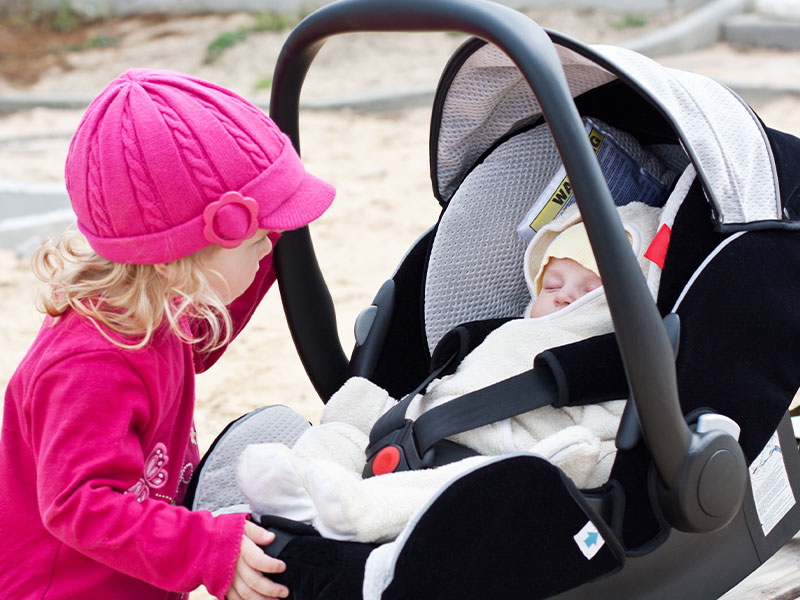
Higher levels of time spent in physical activity are associated with consistently improved: motor development, cognitive development and fitness. Inactivity and sedentary behaviour should be reduced and activity encouraged. The CMO defines inactive and sedentary behaviours as those which involve being in a sitting, reclining or lying posture during waking hours, undertaking little movement or activity and using little energy above what is used at rest. Examples of sedentary behaviours include sitting in a chair, car seat or buggy etc.
We know that containers limit movement and this impacts on their senses, physical development, development of muscles; this can result in children’s spines not developing into the expected ‘S’ shape from the foetal ‘c’ shape. A study published in “Child: Care, Health and Development 2010” examined the motor development of 43 infants allowed to use play-assist containers/equipment. The study found that infants who had the highest containers/equipment usage scored lower on infant motor development, which was measured by the Alberta Infant Motor Scale, whereas the infants with lower containers/equipment usage scored higher on motor development. The study summarised the findings stating that only low – moderate use of containers/equipment should take place within the home and should be avoided in other settings. It also stated that floor-based activities and tummy time were the best options.
We often talk about “Bucket Babies”, this is a term that has been widely used to describe young children that have spent too much time in a confined space. It has also been referred to as container baby syndrome (CBS).
Dr Lala Manners is an expert in early years and physical movement and is the director of the Active Matters website. She states that “Use of ‘containers’ such as buggies, car seats, highchairs and bouncers can seem a practical and safe means of occupying or transporting a baby. However, young children regularly spend up to two to five hours a day in these containers, according to her book The Early Years Movement Handbook.
We have already said that containers are anything that contains a child in a set position or space for a period of time. Dr Lala Manners goes on to discuss in Nursery World articles on physical movement that “‘containerisation’ can result in delays to development. Proprioceptive and vestibular senses can be seriously compromised when opportunities to move freely are curtailed, while sitting in a reclining position for long periods has been found to affect oxygen uptake, with the lungs unable to work at full capacity.”
Dr Lala Manners explains that if we use containers for long periods of time this can lead to Container Baby Syndrome and she states this is more than the containerisation that she referred to above. In a nursery World article in 2021 all about Health and Container Syndrome, herself and Early years consultant, author and trainer Penny Tassoni agreed stating “These conditions can cause movement, cognitive and social interaction problems and may even create problems including: