Early years settings are key and play a crucial role in facilitating and encouraging active environments and lifestyles. If we can develop children’s enjoyment and love of physical activity from the start through activities that stimulate children to develop new skills then we are setting them up to have the healthiest start possible. We know that adults have a huge influence on children’s development, so it is important that we are all Suzy Startwell’s and role model activities as well as being supportive and encouraging as children undertake a range of physical activities. This will improve children’s wellbeing, health and life expectancy.
Free play v’s Structured play in relation to Physical Activity:
Lots of settings set up purposeful physical play opportunities within their environments but they do not always plan for adult structured physical activity to take place. The question we ask you is “do you think your children are getting 180 minutes of physical activity daily?”
Free play environments allow and encourage children to explore and engage in activities and they are given the freedom to choose from a wide range of opportunities that suit their interests. This could also mean that they choose not to take part in activities that do not interest them or they find difficult – physical activity could fall into this category. This makes it difficult for staff to ensure children are accessing a rounded curriculum.
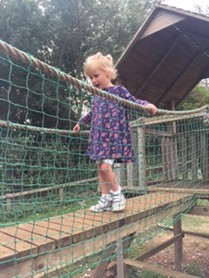
Free purposeful physical play should enable children to face challenges, manage risk, develop resilience and enhance their physical literacy if set up and supported by adults.
Structured physical play sessions are organised and delivered by staff with a focus on developing a particular skill to develop physical literacy.
Active for Life state that “Physical literacy is when a person has the skills, confidence, and love of movement to be active for life.”
Startwell want you to support children to be physically literate ensuring that they are self-motivated and have the confidence and physical competence to move in a variety of ways.
Moving should never be left to chance and to ensure that children are achieving their 180 minutes of physical activity daily can only be done if adults plan and rota in physical activity. Structured physical activity allows adults to plan a range of skills at the children’s level and make adaptations so that children are challenged, but ensuring skills are being met. Remember that for 3–5-year-olds 60 minutes of their 180 Katie should be high intensity where their hearts go Boom, Boom, Boom.
Ask yourself are your children getting their 180 minutes and do you offer purposeful play through a mixture of structured adult led and child initiated play through free flow environments.
Environments
Consider both your indoor and outdoor spaces, as physical activity should be taking place in both areas.
Think about your:
- Opportunity – free flow/ set times etc.
- Safety – risk access not restrict.
- Space – is anything moveable?
- Flooring texture/ textures – soft, uneven, bark, stones, grass, carpet, laminate etc
- Equipment – fixed/moveable/ small/ large/ variety
- Zones – physical areas both gross and fine motor indoors and outdoors
- Music – opportunities and systems indoors and outdoors
- Weather – clothing, shelter, opportunities for all ages
- Planning – is it planned or free flow
- Staffing – who takes responsibility? Who sets it up?
- Local resources – do you use local parks, other settings, soft plays etc
- Open ended – play, opportunities and resources.

National Fitness Day is taking place in the UK on Wednesday, September 24th, 2025. It is designed to be the most active day of the year, what are your plans?
What activities have you got planned to ensure your children are physically active – this is a great opportunity to try new activities.
Activity Ideas:
Why not try some of these activities:
Active Nursery Rhymes:
Babies: Stand up instead of sitting down and use the arms and hands as you undertake the actions for Twinkle Twinkle Little Star, can they bend their knees or dance and move as you sing it? Take a look at an example of some Active Nursery Rhymes for Babies from our Youtube channel.
Toddlers: Stand up and do fast actions for songs instead of sitting down for example 5 little Speckled Frogs – can they all jump about like frogs and do the actions, or can you use an elastic and do Row, Row Row your boat standing up and make exaggerated movements.
Pre-schoolers: Ring games encourage movement can the children do Down in the Jungle, Ring a Ring a Roses and Head Shoulders Knees and Toes. Remember to be as enthusiastic as possible and move to your maximum.

Obstacle Courses
Babies: Can you create crawling courses where children crawl through tunnels, under tables, over textured mats, walk over large planks with support.
Toddlers: Can you create walking courses where children crawl through tunnels, walk over large planks, step in and over hoops and tyres, climb in and out of boxes, roll of floor mats and through an object towards an object to finish.
Pre-schoolers: Can you create high intensity locomotor courses or manipulation courses where children move at pace and complete tasks such as weaving in and out of cones, running over planks, jumping on and off obstacles, throwing and catching objects etc.
Check out our Pinterest Pages or our Activity Ideas section for more ideas on the website.