The government has published new, evidence-based guidance to help parents of under 5s navigate screen time, offering practical advice to support informed choices to help little brains develop healthy screen habits.

Keep mealtimes and bedrooms screen-free, and try swapping screens for reading, play, and conversation. Young children copy your habits, so try to limit your own screen use around them. An important point to remember is that screens shouldn’t replace young children’s sleep, physical activity, play or quality time.

Following this the Department for Education have published guidance on how to limit children’s screen use in settings and ensure it supports the children’s learning and development. The guidance includes the difference between screen use and screen time and includes useful reflective questions to think about your own practice. Settings need to consider how, when and why screens are used and ensure that their approach supports children’s learning, development and wellbeing.

From Startwell’s experience, screens are sometimes used for activities such as Wake Up Shake Up sessions and reading stories. We encourage staff to be active role models, like Suzy Startwell, and lead Wake Up Shake Up themselves. Children are likely to find joining in with a familiar adult more engaging than following instructions on a screen. Settings can also bring books to life through active stories, using actions, movement and role play rather than showing a story on a screen. As screen use can encourage sedentary behaviour, these approaches help create more opportunities for children to move and be active, just like Active Azra.

For more advice on how to help little brains to develop healthy screen habits visit the Best Start in Life website.

In June, the Startwell team delivered three face-to-face Powering Healthy Settings events. We were delighted to welcome 58 settings, 76 Early Years Practitioners, and 3 Health Visitors across the sessions.

Feedback from the events has been overwhelmingly positive, with practitioners describing the training as highly informative, engaging, and full of practical value. Attendees particularly valued the breadth of knowledge shared, including a deeper understanding of active play, processed foods, and supporting children’s wellbeing. Many highlighted how the sessions introduced new ideas and approaches that can be easily implemented within their settings, helping to enhance everyday practice and activity planning.

The interactive, face-to-face format was a key strength, with participants appreciating the opportunity to take part in hands-on activities and experience them as children would. The workshop structure, including smaller group sessions, encouraged participation, discussion, and the sharing of ideas. The Startwell team were praised for their friendly, clear, and non-judgemental delivery. Overall, the events not only provided valuable knowledge but also boosted confidence, leaving practitioners feeling inspired, better equipped, and motivated to apply what they had learned in their work.

Over the coming months, we will be sharing further insights from the events, including the positive impact Startwell has had on your settings and families, as well as the challenges identified in implementation and how we can support you to overcome these.

We look forward to continuing to work together to create healthier, happier environments for children to thrive.

The Startwell team have seen a few staff changes over the last month. We have said goodbye to Mel Cox and Becky Inshaw from the team.

Mel has stayed working in the wider Dietetic team working on a more clinical role support patients at GP surgeries. The Startwell team would like to thank Mel for all her hard work over the last year and will miss her contribution.

Becky has been with the team for a long time and the team are very sad to see her go. We will miss her creativity and positivity greatly. Becky has written a message to say goodbye to you all personally –

‘After 10 wonderful years working on the Startwell Programme, I’ll be saying goodbye to my role as Physical Activity Lead. It’s been an incredible journey being part of a programme that has such a positive impact on the health and wellbeing of so many families across Birmingham.

I’ve loved visiting early years settings across the city and seeing the Startwell characters come to life and witnessing the passion, creativity and dedication of practitioners who work so hard to give every child the best start in life. It has been a privilege to support you all in promoting healthy eating, physical activity and oral health in your settings.

Leaving a role and team that I’m so passionate about hasn’t been an easy decision. However, after welcoming our second son, I’ve decided to take some time to focus on my young family and explore a new chapter – building my Pilates business (Sammy Skills, would be proud for sure!).

I’m incredibly proud of everything Startwell has achieved and of the amazing team and settings who continue to make such a difference every day. Thank you for making this journey so inspiring, I’ll always be cheering you on!’

Startwell wish both Becky and Mel lots of luck for their future endeavours.


District setting support

Here is a current list of which Startwell staff are supporting each district.

  • Sarah Bates – Team Leader – Hall Green and Northfield
  • Teresa Johnson – Nutrition Lead – Erdington, Perry Barr, Sutton
  • Claire Hamilton – Early Years Lead – Yardley, Hodge Hill, Edgbaston, Selly Oak, Ladywood

Did you know early years settings like nurseries can order and distribute their own Healthy Start vitamins? The vitamins will be delivered directly to your setting which you can then give out to your registered families. In Birmingham, Healthy Start vitamins are free to all children under 4 years old and to all pregnant people from the start of their pregnancy up until their youngest child reaches 1.

What do Healthy Start vitamins contain?
Healthy Start Vitamins provide important nutrients for growth and development. The vitamin drops for children contain vitamins A, C and D. The vitamin tablets for those pregnant and breastfeeding contain folic acid and vitamins C and D. Vitamin D is important for the development of healthy bones and teeth. As infants grow at a rapid rate it is important that both the pregnant person and baby get the required amount.

Who do I contact?
If you are interested in issuing Healthy Start vitamins at your setting or want more information on what is involved, please contact Birmingham City Council’s Public Health Team at publichealthcypteam@birmingham.gov.uk

For further information visit the Healthy Start page on our website!

Beezee Families is a 12-week programme for children and young people aged between 5 – 12 and their families which explores ways families can make healthy habits together in a supportive, non-judgemental space. With the expert guidance from their team, families can:

  • Discover the joy of movement
  • Learn about a balanced diet
  • Learn from the comfort of their own home

Click here for the BeeZee Families flier.

As you welcome new children into your setting, why not use your “All about me” topic as a way of introducing the 8 Startwell characters.  It is an excellent opportunity for practitioners, children and their families to learn more about each Startwell character and their key messages.

Activities for practitioners

The activities below are for practitioners during team meetings or room meetings to increase their knowledge and confidence in the Startwell characters and their messages:

  • Assign a Startwell character to each practitioner and ask them to research from the Startwell website. Share at your next team meeting
  • Play the Startwell character cube game, ask each practitioner to name a fact about the character and an activity idea
  • Practitioners to complete the Startwell quiz
  • Look at the practitioner activity ideas on our website
  • Check out the Startwell character boards on Pinterest
  • Watch our Startwell workshop videos to get confident using the Startwell character cards with your children
  • Thread the Startwell characters through your daily routines
  • Create additional Startwell character resources e.g. wooden spoons, peg dolls, wooden discs, lanyards etc.
  • Choose a Startwell character. Which Startwell character would you be and why?

Activities for Children

  • Play the Startwell character cube game (included in your Startwell resource pack)
  • Sing the Startwell character songs
  • Decorate the Startwell character crowns
  • Play with the Startwell character masks
  • Can they draw their favourite Startwell character.
  • Hold a Startwell week to explore all the characters
  • Choose a child to be Suzy Startwell each day and ask them to put the Startwell character cards out daily to use throughout the day.

Startwell Resources

In addition to all the resources above, we also have the following:

Ideas for Sharing with Families

  • Use the printable Startwell characters on your display boards
  • Share the Startwell character summary sheet
  • Add a regular Startwell section to your newsletter
  • Share the Startwell activities for families to try at home. These are updated termly and age specific (babies, toddlers, pre-school)
  • Share any Startwell social media posts relevant to your families
  • Share any Startwell newsletter articles relevant to your families

We hope you found this useful.  We would love to see how you are using the Startwell characters in your setting.  Please tag us in your social media posts, share with your Startwell consultant or email us at bchc.startwell@nhs.net

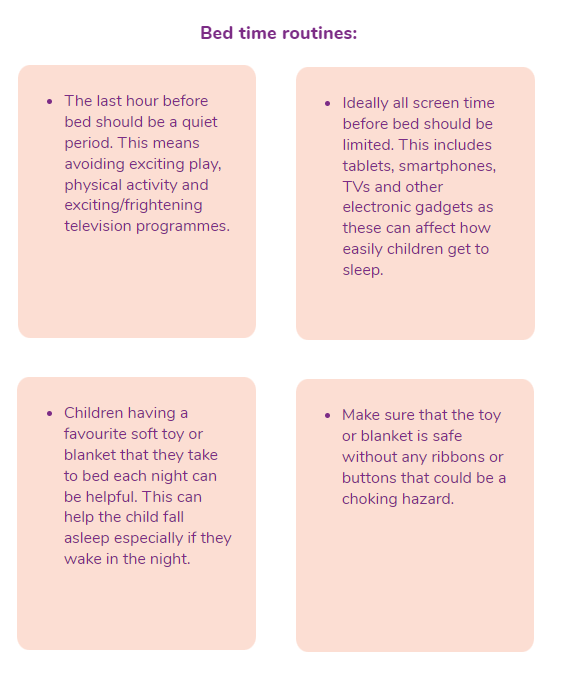
Hopefully you saw in our events calendar that 1st – 31st March is National Bed Month. Many of you may be wondering why Startwell, who want us to have active lifestyles, is promoting bed month. The answer is because it is so important to get a good night’s sleep, both for children and adults. If you are sleep deprived you are less likely to be active and more likely to eat high sugar/fat foods so National Bed Month is an important time to talk about good bedtime routines and the importance that sleep has on our bodies.

There is now strong evidence that lack of sleep increases the risk of childhood obesity. Current evidence recommends that pre-school children should be getting a minimum of 10-11 hours sleep per night. Talk to parents about a bedtime routine and how this can help children to get a good night’s sleep. Once a bedtime routine has been established that suits the family, consistency is important. Children will get used to their bedtime routine and understand what is expected of them. Hopefully leading to a good night’s sleep for the child.

Children who sleep well will also allow their parents to get a good night’s sleep! This is important for parents own health and wellbeing and will then allow them to have the energy to be good role models like Suzy Startwell and encourage their family to have active lives and consume nutritious food.

For more information on sleep visit our website’s sleep page.

March is National Bed Month and there is increasing evidence that lack of sleep is linked to childhood obesity. Good sleep for children is linked to many benefits for their physical and mental health including maintaining a healthy weight. Current evidence recommends that pre-school children should be getting a minimum of 10-11 hours sleep.

Settings should be encouraging parents to ensure their children get good quality sleep of a suitable length for their age. Bed time routines can be discussed with parents to try and encourage a good sleep.

It is important that a bedtime routine is consistent and the bedroom environment is the same every night. The bedroom should be cool, quiet and dark without a TV in the room. A story in the child’s bedroom is a calm and relaxing way to end the bedtime routine. Do not let the bedtime routine be too long. 60 minutes is a reasonable time limit. Ideally your child should be taken to their cot or bed while they are still awake so that they can learn to fall asleep without you.

Children will get used to their bedtime routine and understand what is expected from them. This will hopefully lead to a good night’s sleep for the child.

For more information on children’s sleep and bedtime routine access the Sleep page on our website.