In August 2024 the Food Standards Agency produced guidance on handling flour and flour products safely. This guidance applies to all types of flour including wheat, gluten free, corn, gram, and rice flour and it may also be helpful when considering the risks associated with sensory play and craft activities using flour where this is not intended to be eaten.

Read the full guidance here.

A summary of the guidance is below:

Tips to help you to prepare food using flour or flour products safely

  • do not eat or taste uncooked flour or flour products, such as pastry, cookie dough, pizza dough and batter, such as cake mix, unless labelling indicates they are ready to eat. This is because flour is not usually treated during processing to kill any food poisoning bacteria that may be present.
  • keep flour and flour mixes (e.g. bread or cake mix) in a sealed bag or container – flour can spread easily and contaminate other foods
  • follow cooking, storage and handling instructions provided on the packaging. This will also tell you if the product can be eaten raw.
  • wash hands thoroughly with soap and warm water before and after handling flour, uncooked pastry, or dough
  • clean all surfaces properly – wash bowls, utensils, and surfaces with warm, soapy water or your usual surface cleaner and disinfect where necessary

It is particularly important for vulnerable people, such as young children, those with compromised immune systems and older people, to follow this advice because their immune system may not be able to fight off infections as easily. They should also take care when handling flour and flour products and follow the advice on the 4Cs: cooking, cleaning, chilling and avoiding cross contamination.

Messy food play is fun, a great way to develop children’s fine motor skills, and can encourage reluctant eaters to try different foods.  However, always conduct risk assessments before doing these activities as children with allergies can have a reaction to touching or inhaling the food they are allergic to and choking may also be a risk even if the food is not intended to be consumed.  If using uncooked flour or flour products in ways not intended to be eaten e.g. dough for crafts and flour for messy play, you may wish to use the advice listed in the FSA document when conducting risk assessments.

Here is a link to a cooked playdough recipe that you may want to use instead.

Other ideas of food that can be used in messy/sensory food play are cooked pasta, peas, baked beans, dried pasta, breakfast cereals, breadcrumbs, cooked porridge oats, mashed up fruit like bananas and citrus fruits (lemons, limes, oranges).

The World Health Organisation recommends that children up to 2 years old have no screen time and children aged 2 to 4 have maximum 1 hour per day. Startwell NHS supports and follows the WHO guidelines. Screens are defined as TV’s, Tablets, Mobile phones, Games console, laptops or Computers. Screen time is defined as someone watching or playing on a screen either for entertainment or education.

A survey of 1,000 British mothers of children aged 2 to 12 found that 85 percent of mums admit to using technology to keep the kids occupied while they get on with other activities. The AO.com survey pointed to children spending on average around 17 hours a week in front of a screen – almost double the 8.8 weekly hours spent playing outside. Ofcom in the UK estimates that the average 3-4-year-old spends three hours a day in front of a screen.

Children are spending too much time using technology and research also highlights that children who have excessive screen time also do worse at their GCSE’s. The WHO advises that screen time should be replaced with more time for interaction, physical activity and sleep.

Research from Action for Children found that nearly a quarter of parents struggle to get their children to “unplug” and take part in activities away from television, phone and computer screens. When asked which behaviour they found most difficult to control in their children, parents said they struggled to limit technology-based activity.

Impacts of screen time in under 5’s:

  • Babies’/ young children’s brains are still developing and cannot effectively learn from screens.
  • Social interaction cannot take place effectively through a screen leading to difficulties with social skills.
  • Social and emotional development Is Impacted by too much screen time.
  • Delayed language development
  • Disrupted sleep
  • Attention and learning difficulties
  • Increase in behavioural problems and emotional outbursts especially when technology is removed.
  • Physical development Is delayed.
  • Educational attainment Is reduced

Babies and children learn best through hands on and real-life experiences:

Technology cannot replace these experiences meaning children that have early screen time are missing out. Instead try:

  • Crazy Dance Time – move anyway you like to a range of music
  • Helping round the home – recycling, sweeping, vacuuming, tidy toy time

Check out Startwell’s website for more activity ideas https://startwellbirmingham.co.uk/

It is important for children to have the opportunity to explore outdoors in all weathers. There are many articles and books written to state that it is good practice, and children should have access to outdoors in all weathers. You may have heard the saying “There isn’t such a thing as bad weather its bad planning that makes the difference” Think back to when you were little – where was your favorite place to be? At Startwell we believe that playing outdoors in all weathers offers so many opportunities and experiences that it needs to be an integral part to every child’s day. Children of all ages should be given the opportunity to be outdoors.

Margaret McMillan, Educationist and Theorist of Nursery Education states “The best classroom and the richest cupboard are roofed only by the sky”

In order to access outdoors in all weathers a setting has many elements that it needs to consider such as:

  • Risk Assessments – Challenging weather creates real and perceived risks, and so risk creates opportunity for growth, because risks teach. In today’s society we worry about bumps, bruises, accidents, and in settings we have become paper heavy with risk assessments and even have risk assessments for completing a risk assessment! Risks are real and do have consequences that teach us to be aware; aware of ourselves, others, our environment, resources and nature.

Most challenges, risks, and hurdles are swiftly removed from childhood in efforts to prevent anything bad from happening to the children we love, but this may be robbing children of life’s challenges and not preparing them for the realities of being an adult. (Taken from Wild Earth):

‘One of the best ways to help children to learn about risk is to teach them how to deal with difficult and tricky situations by allowing them to experience them in controlled conditions. Removing risk is not the answer. Life is not risk-free. Risk needs to be part of a child’s education.’  (Chief Inspector of Schools, Ofsted, UK)

  • Clothing – It’s important that children and staff have appropriate clothing so that they can access outdoors in all weathers. This may include sun hats, welly boots, gloves, woolly hats, lots of layers, spare clothes, warm boots, waterproof all in ones/coats etc… This list could go on and is only a snap shot to help you get started.
  • Parents’ Wishes/ Policies – You need strong and consistent policies that reflect your settings ethos and remember to keep the children at the heart. Parents often feel being outdoors will make children ill or worse if they already have a cold– they associate being outdoors with the cause but actually being in warm environments that allow bacteria and viruses to spread are often the cause of colds, flu’s etc. Fresh air is good for you. Richard Louv, author of eight books about the connections between family, nature and the community, says that ‘children who play outside are less likely to get sick, to be stressed or become aggressive and are more adaptable to life’s unpredictable turns’.
  • Resources- Some settings will be lucky enough to have canopies or covered areas. But in reality, we can only work with the space and resources we have. Please think about sun creams, umbrellas, outdoor brooms, snow shovels, outdoor taps etc.

The weather in the UK is unpredictable and already this year we have had snow, ice, torrential rain, blistering sun, high winds etc.. If we limit children to going outdoors when “it’s nice” we would never be outdoors.

Benefits of being outdoors in all weathers:

  • Boosts immune systems
  • Encourages absorption of vitamin D
  • Improves mental health.
  • Improves physical health.
  • Improves sleep.
  • Improves the sensory experience of listening to and feeling different weather conditions such as the wind, rain, and snow.
  • Increases their knowledge of the environment:
  • Discovering about seasons and the changes that happen in the environment such as crunchy leaves falling off the trees
  • Supports holistic development
  • Develops risk awareness that comes with different weathers such as drinking lots of water and sun cream when it’s hot, or being careful of ice when it’s cold
  • Discovering about living things in the environment when the weather changes for example frogs may come out when it rains
  • EYFS learning experiences such as painting with wet mud when it’s raining or catching rain in containers and talking about quantities and numbers
  • There is a huge push in the new EYFS and in current documentation to support settings to realise that outdoors in all weathers is vital for children’s long term health and wellbeing.
  • Fun activities such as den building to keep dry or to provide shelter from the sun, splashing in puddles, crunching leaves, minibeast hunting and much more

Into the Woods Outdoor Nursery, UK states ‘The chance to connect with the natural world; first hand experiences of life and growth; endless opportunities for creativity and imagination; improved fitness and physical development – the countless benefits of outdoor play have a real positive impact on children’s lives.’

A few play ideas could include:

  • Jumping in the puddles
  • Watching for parretns that tht erain makes in the puddles
  • Bubble play – blowing bubbles in all weathers
  • Nature walks – listening for sounds
  • Water play
  • Outdoor stories
  • Running races
  • Lead printing
  • Windmills – watch them move in the wind
  • Treasure hunts in the snow – follow the flags to find the prize
  • Target practice with snow balls
  • Listening to the rain on the umbrellas
  • Speedy slides
  • Nature hunts
  • Flying kites
  • Forest schools
  • Dancing
  • Leag hunts
  • Leaf Jumping
  • Painting snow and ice
  • Building snow characters
  • Sledging

It is important to involve parents in your outdoor ethos so they are aware that their children will go out in all weathers and take part in a range of activities. Why not do outdoor activities and workshops with parents so they can see what you are doing and the benefits of being outdoors. (We want to step away from the “my child can’t go outside as they have a cold”- we all know going outside and fresh air helps to kill germs and build resistance not reduce it, If they aren’t well enough to go outside to play and participate fully in the nursery day then are they well enough to be in your setting?)

Children do not catch a cold from ebing outside in the cold… it’s a myth, research shows you’re safer from colds when you’re outside than when you’re inside!

The increasing level of illness that accompanies the colder months has left many parents to believe that the cold weather has given their kids a cold. It’s in the name, isn’t it? A cold? – Charlie Elizabeth Culverhouse 3/02/2024 NEWS/ Nursery World

“Children do not ‘catch a cold’ by playing outside during the Winter,” Adrian Preuss, a Nutrition Scientist states. “Research confirms that the opposite is true, and children who spend time outside get less sick, backed by evidence.  So please allow your kids to play outside to boost their immune defence.” Quote shared by Adrian Preuss (@nourishherbody)

Child Care Health Consultant Anne Dodds is just one of many experts praising the benefits of winter play alongside Preuss., “Winter fresh air is good for everyone! Outdoor winter play has long been blamed for colds and the flu. Our parents told us to ‘bundle up or you’ll catch a cold,’ and their parents probably told them the same thing.

“Although going outside unprepared for the elements is unwise, viruses that are spread by other human beings and cause colds and the flu are indoors. The indoor circulation of germs and bacteria is much more harmful to your child than playing outside.”

Many Health professionals from within the NHS and beyond are promoting the importance of being outside in all weathers as long as you are dressed appropriately. Being outside helps build immunity and reduces the risk of catching germs. There are more benefits to Health for being outdoors than there are for being Indoors.

The DFE (Department for Education) states that during cold adverse weather early years setting should:

  • Ventilate indoor spaces, especially those where people gather, even for short periods each day to help reduce the risk of spread of infection.
  • Encourage children to move more and be physically active.
  • Promote vaccination for flu for children to help reduce risks from respiratory infections during the winter and encouraging parents and carers to keep their children up to date with routine immunisations.
  • Reinforcing public health messages around hand washing and respiratory hygiene and taking other steps to prevent the spread of infections during the winter such as opening windows and going outdoors where possible.
  • Provide advice on appropriate clothing for adverse cold weather, ice or snow to families
  • providing parents with information on children attending school or early years settings when ill.
  • Make sure rooms are not too hot as hot rooms Increase the risk of germs and also cause children especially babies to overheat.

This month we are excited to showcase 3 Startwell settings. Two settings have completed the Startwell Advanced Award and 1 setting has recently renewed its Startwell Award after 2 years. We would like to thank Shenley Fields Daycare, Smart Start Childcare and Sammy Snails Nursery for sharing their Startwell experience and successes.

Shenley Fields is a great example of embedding Startwell characters and messages into their everyday practice, Smart Start focusses on improving the drinks and snacks that parents send into nursery, and Sammy Snails looks at making sure each character gets equally developed within their setting

Following a recent report from the Scientific Advisory Committee on Nutrition (SACN) SACN report: feeding young children aged 1 to 5 years – GOV.UK (www.gov.uk), there have been changes to NHS advice and webpages.

Children can now have either pasteurised whole (blue top) or semi-skimmed cows’ milk (green top) as a main drink from age 1 year as well as pasteurised goats’ and sheep’s milks.  This means you can offer children from 1 year of age semi-skimmed milk as a main drink.  Semi-skimmed milk has the same amount of protein, calcium vitamin B2 and vitamin B12 as whole milk.

Skimmed milk and 1% cows’ milk should not be given as a main drink until 5 years of age because they do not contain enough fat.  They can however be used in cooking from the age of 1 year.

For more information on suitable drinks for children under 5, please visit our Startwell Drinks webpage.

The Early Years Foundation Stage (EYFS) statutory framework is mandatory for all early year’s settings, including maintained schools, non-maintained schools, independent schools, all nurseries and childminders on the Early Years Register. It sets the standards that all early year’s providers must meet to ensure that children learn and develop well and are kept healthy and safe.

The consultation on changes to the EYFS, took place and is proceeding with implementing two versions of the EYFS framework: one for childminders and one for group settings. For more information and to look at all of the changes implemented please follow the link: Early years foundation stage: regulatory changes

With a focus on the healthy element, Startwell is aiming to support settings to improve their understanding and quality in the areas of Physical development, Nutrition, well-being and Oral health.

Startwell are really pleased that Physical Development (PD) is a prime area of the EYFS and that FMS is highlighted within it.  EYFS profile data from 2022/23 reported an increase of children with a good level of development by around 2 percentage points across all 17 early learning goals. Physical Development was still the area of learning with the highest percentage of children at the expected level.

According to National Data girls are outperforming boys by over 6% on Gross Motor skills and 12% on Fine motor. West Midlands Data is very similar with girls outperforming boys by just over 6% on Gross Motor skills and 13% on Fine motor.

“Notably, however, the EYFSP is not based on any standardized measurement of FMS”. L Eddy (2021)

At Startwell we are always surprised that PD scores so high in the ELG’s as we often see children not reaching FMS milestones and staff often highlight that they do not plan / deliver FMS based sessions on a regular basis. Whilst PE in schools is compulsory, how it is taught and assessed is not specified.  At the end of the Early Years Foundation Stage Profile (EYFSP) there is no formal screening for FMS and teachers only record a single judgment of whether they feel a child’s ‘moving and handling skills’ are ‘above’, ‘at’, or ‘below’ highlighting an area of weakness in the system and a possible reason as to why PD is scoring such a high percentage. This has led to calls for routine school-based screening of children’s FMS to improve this area and have more standards set to gain a clearer picture of PD although this is still not in place.

There are many reports that suggest that failing to acquire FMS at the appropriate age may increase the risk of a child experiencing long-term physical and mental health problems with a focus on social and emotional problems as well as affecting educational attainment focusing on reading, language skills and maths. L Eddy (2021)

Studies have suggested that a large proportion of children are unable to perform age-appropriate Fundamental Movement Skills (Brian et al., Citation2018; Farmer et al., Citation2017; O’Brien et al., Citation2016). The PE and Sport Premium was introduced to help primary schools improve the quality of PE and sport activities they offer after it was highlighted as an area for improvement.

From discussions with practitioners and teachers we are aware that there is still a huge skills gap in physical activity and the best way to close this gap is to train and inform practitioners of the different FMS that children need to develop and ways to support their development.

Questions to ask your staff team are:

  1. Do they know what FMS stands for?
  2. Do they understand each of the FMS?
  3. Are they planning for the skills?
  4. How often are they planning/ providing skill based focused activities?
  5. Are they able to differentiate the skills to offer more challenge or to make it more accessible?
  6. Are they accessing the children’s skill development?
  7. What extra support is given to children who are not meeting their FMS?
  8. What training have they done in relation to PD and FMS?
  9. What extra training would they like?
  10. Are they undertaking sensory circuits in the setting?

If you want to find out more about FMS please speak to your Startwell consultant and book onto our physical training.

References:

EYFS https://www.gov.uk/government/publications/early-years-foundation-stage-framework–2 (2023)

Fundamental Movement Skills and Their Assessment in Primary Schools from the Perspective of Teachers Lucy Eddy (2021) https://www.tandfonline.com/journals/hmpe20

Sutton Outdoor Preschool is Birmingham’s first fully outdoor pre-school setting based in Sutton Park. It provides early education for children aged 2-5 years old during Birmingham term time.

Startwell have had the pleasure of working with Sutton Outdoor Preschool on the Startwell Award and we caught up with Liz (Preschool Manager) who has given us her top 5 tips for a successful outdoor setting.

Our Top 5 Tips:

  1. Dress for the weather. This applies to all participants – children and adults! Lots of thin layers overlapped are more beneficial than a few thick layers. Quality waterproofs.
  2. Be enthusiastic! Children enjoy being outside but will pick up on any negativity from adults so, embrace it, follow the children’s lead and relive your inner child! Suzy Startwell!
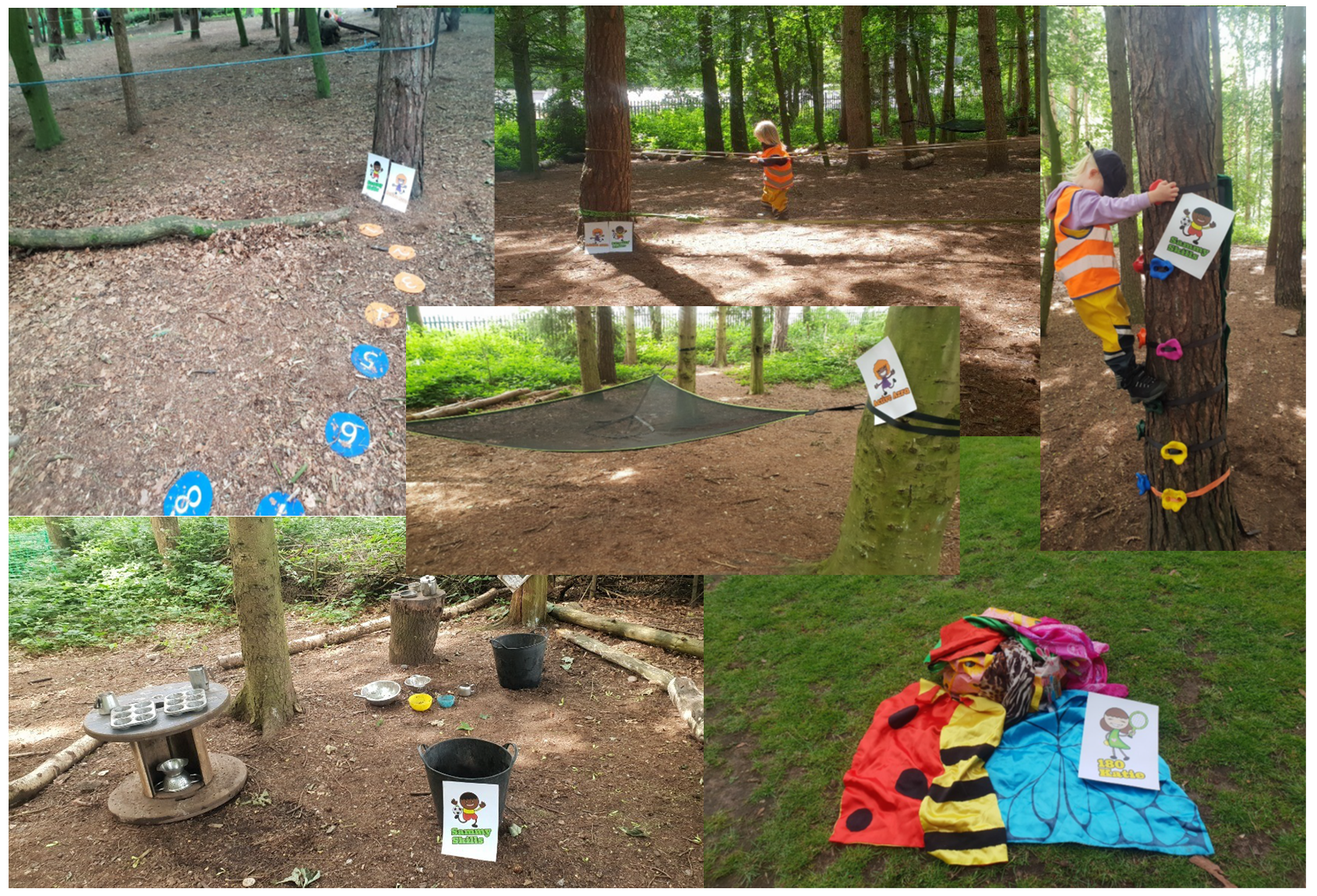
  3. Make the most of the space and resources available. Provide hidey spaces, “wild areas” where bugs might live, open-ended loose parts (planks, logs, wood slices, tree stumps, sticks, tarps for shelters…) Allow children to help set up the area based on their own ideas. Involve them in planning and designing. Think outside the box.
  4. On cold days embrace Active Azra and move more! If children are on the move they are active therefore warmer. Hide pictures for children to run and find, create a movement trail (hop to the mud kitchen, run to the tree…) or an obstacle course. Use timers to encourage children to “beat their own time” (and incorporate some maths at the same time). Adult participation also required (Suzy Startwell)!
  5. Don’t overthink it! Children cannot help but learn from their natural surroundings. Sometimes as adults we forget the awe and wonder, the physical opportunities and offer of creativity and imagination which the outdoor environment provides. Sometimes we just need to stand back and let the children show us how it’s done!

Here is a shopping list of some of Liz’s favourite pieces to use in the outdoor environment (Note: Startwell do not endorse any specific products, these are all examples):

  1. Didrickson’s waterproof coat and dungarees. Designed especially for little ones to keep them warm and dry while they play and learn. (They’re available from various companies online)
  2. A Hammock is great fun for the children to explore and play with.
  3. Three point hammocks are also a great social space, be it on top or hiding under.
  4. Climbing holds for trees are great for developing stability like Sammy Skills and won’t damage the trees so can be packed away too.
  5. Children’s outdoor digging set. Long and short handled digging tools are great for the children to use. (They’re available from various companies online)

Thank you to Liz and all the children at Sutton Outdoor PreSchool for the insight into their setting. If you would like more information about the preschool please contact Liz. Contact details: Liz Leddy, Preschool Manager: liz@suttonoutdoorpreschool.co.uk  07460 324 244

All our Startwell Award settings that complete are given a certificate that has a 2-year expiry date on it. This helps us to ensure the practice is maintained within the setting. After completion, Award settings receive a quarterly email from their Startwell NHS lead, and they also receive an email after a year that is a reminder that the certificate has an expiry date and ways to keep engaging. At 18 months another email is sent and then the allocated lead makes contact to book in a review meeting date. During the 2 years, settings are expected to keep embedding their Startwell practice into their everyday routines and activities and keep evidence of some of these.

Review meetings are your opportunity to show us any evidence, activities, and the good practice that you have been doing in the 2 years since we saw you last. It should be a celebration of the work that you have been doing in your setting to help tackle Childhood Obesity and create healthier lifestyles. We ask that you complete a case study, or a power point and a set agenda is sent to you prior to the meeting so you know what we will be looking for.

I recently undertook a review meeting at Rocking Horse Kindergarten and with their permission I wanted to share elements of their power point as it is a fantastic example of how to share and celebrate the work that you have been doing.

They were clear about what had gone well in their setting – they shared their good practice and shared pictures of the displays that they have created in the setting. They shared examples of activities undertaken and how they have used the characters in each of the rooms.  We were able to talk about how the characters are used in each of the rooms and ways that they could be extended and enhanced.

They went on to share what they continue to do and what they want to work on within the setting to improve Startwell practice and create a healthier environment for the children.

If you require any information before your renewal meetings, please don’t hesitate to get in touch with your Startwell lead. We are looking to see how you have continued to use and share the knowledge that you had from Startwell with the children, staff, and families. We are especially interested in how your setting uses the characters in everyday practice.

Thank you again to Rocking Horse Kindergarten for allowing us to share their good practice.

Last year we commissioned Coventry University to carry out a study on the knowledge, practices and perceptions of Early Years Practitioners on pre-school healthy eating and physical activity. The study looked at Startwell settings and matched early years settings in Coventry (control settings).

The survey was completed electronically by early years practitioners. 77 staff from Startwell settings and 60 staff from the control settings completed the survey. The results from the study are really encouraging. Startwell training came through as a huge benefit that the control settings do not have. The survey showed that Startwell settings had better knowledge of the current nutrition and physical activity guidelines compared to control settings. The Startwell settings also report greater confidence to teach nutrition and physical activity to the children in their settings. Showing that they can successfully transfer the knowledge learnt in Startwell training into practice.

The control settings reported that they didn’t have access to healthy eating and physical activity resources and voiced this as a barrier to implementing healthy eating and physical activity in their settings. We are pleased to see that Startwell settings felt that they did have access to resources for both healthy eating and physical activity. This is brilliant to see that Startwell settings are using all the resources we provide in training and on our website and feel these benefit their work.

Other key results showed:

  • That more practitioners from Startwell settings tried to drink water in front of the children compared to the control settings (87% of Startwell settings staff compared to 40% of control settings staff).
  • That more practitioners from Startwell settings felt that celebrations and events in their settings supported healthy eating messages compared to control settings (73% of Startwell settings staff compared to 33% of control settings staff).
  • That more practitioners from Startwell settings felt that they had a good understanding of the importance of fundamental movement skills compared to control settings (90% of Startwell settings staff compared to 57% of control settings staff).
  • That more practitioners from Startwell settings knew the correct amount of vigorous intensity physical activity 3-4 year olds should have each day compared to control settings (62% of Startwell settings staff compared to 16% of control settings).

A barrier that was identified by Startwell settings (and control settings) was lack of support from parents and families around healthy eating and physical activity. We will look at this element further and try and identify areas where we can help. We will continue developing new resources as the survey showed that these are important and useful to practitioners with a focus on resources to engage parents and families.

In conclusion practitioners from Startwell settings demonstrated that they had better knowledge and understanding, more positive practices and fewer barriers to practice in relation to healthy eating, physical activity and fundamental movement skills compared to a matched control group of non-Startwell settings.

We wanted to say thank you to all settings that participated in the study and to Coventry University. The full report will be available soon on our website.