
The results of the seventh National Dental Epidemiology Programme (NDEP) oral health survey of 5 year-old schoolchildren in England in 2024 were published last month. The data was collected during the 2023 to 2024 school year. This survey takes place every 2 years to collect oral health information of 5-year-olds who attend mainstream, state-funded schools across England.

For the second time in this series of surveys on 5-year-olds, the prevalence of children with enamel decay is presented. Understanding the prevalence of enamel decay is useful as it tells us about the proportion of children with early-stage decay who would ordinarily be counted as being free of obvious decay. This is presented at national and regional levels.

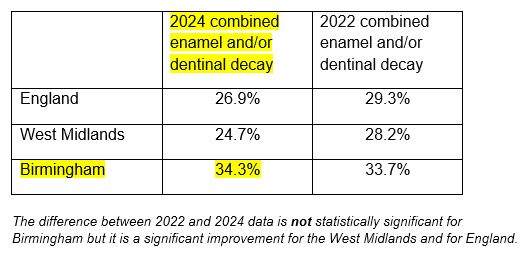
The table below summarises the prevalence of combined enamel and/or dentinal decay experience between 2022 and 2024:
Nationally, 22.4% of 5-year-old children had experience of dentinal decay. Of those with experience of dentinal decay, the mean (average) number of teeth affected was 3.5 teeth. Children living in the most deprived areas of the country were more than twice as likely to have experienced dentinal decay (32.2%) as those living in the least deprived areas (13.6%).

The table below summarises the prevalence of experience of dentinal decay between 2019 and 2024:

For further information on the NDEP and to view the data tables, click here

Poor oral health impacts both children and their families. It causes pain, discomfort and infection for the child and impacts their ability to eat, smile and socialise. Children need time off school and parents and carers need to take time off work to take their children to dental appointments. Dental decay is related to frequent consumption of sugary foods and drinks and therefore is largely a preventable disease.

Startwell have our very own oral health character Smiley Shen who teaches children and families how to keep their teeth healthy!

We want you to promote oral health all year, however it can be useful to link to national campaigns such as National Smile Month which takes place from 12th May to 12th June and promote this in your setting.  For further information have a look at our National Smile Month newsletter article. For ideas on how to promote oral health messages in your setting and how to link our Startwell character Smiley Shen visit our website’s activities ideas pages.

If you would like to access free oral health training for early years practitioners you can book via the training dates page on our website.
 

National Smile Month is the UK’s largest and longest-running campaign to promote good oral health. It is an annual event run by the Oral Health Foundation all about championing the benefits of having good oral health and promoting the value of a healthy smile.

This year’s campaign runs between 12th May and 12th June 2025 and is focusing on the powerful connection between diet and oral health with the theme, Feed Your Smile.  Our diet, which is the food and drink we eat each day, plays a crucial role in maintaining a healthy smile, healthy teeth and healthy gums.  Feed your smile wants to help you make smart choices that promote oral health every day.

Did you know that in Birmingham, the most recent data from the National Dental Epidemiology Programme (NDEP), shows 34.3% of 5 year old children had experience of combined enamel and/or dentinal decay in 2024 which is higher than the national average and the West Midlands region:

This is despite the fact Birmingham’s water is fluoridated and tooth decay is largely preventable.  Startwell promotes good oral health through our character Smiley Shen who encourages us to keep our teeth clean and healthy.  He tells us that even our first set of teeth, our ‘milk teeth’, are important as children use these to learn to eat, chew and speak, plus they are making the spaces for our adult teeth. To find out more about Smiley Shen Click Here.

What can you do in your setting to support National Smile Month? 

Promoting Oral Health in setting

Oral Health is a topic which should be promoted all year round and the EYFS requires early years practitioners to support, encourage and promote good Oral Health. Here at Startwell we have created a range of age specific Smiley Shen activities for you to do with the children in your care. There are examples for babies, toddlers and pre-school on our website

We also have our Smiley Shen Pinterest Board with lots of ideas.

Other ways to promote Oral Health:

  • Ensure the snacks you serve are based on fruit and vegetables (but avoid dried fruit at snack time)
  • Limit sugary desserts to once a week at lunch time
  • Only milk or water should be served to the children in age-appropriate drinking vessels. No other drinks should be consumed in the setting.
  • Display and talk about our hydration characters to encourage the children to drink more water
  • Be a good role model and let the children see you drinking water too
  • Add a note to your registration forms to ask families for the name of their dentist. If they are not registered, signpost them to their nearest NHS dentist
  • Share the Smiley Shen activity ideas for families to do at home. There are examples for babies, toddler and pre-school children
  • Create a Smiley Shen take home bag
  • Set up tooth brushing with the children in your setting

Remember the 3 key messages for better Oral Health:

  • Brush teeth for two minutes twice a day with a fluoridated toothpaste (last thing at night and one other time during the day)
  • Reduce your intake and frequency of sugary foods and drinks.
  • Visit a dentist regularly.

Please make sure you communicate these important messages to your children and families via email, displays, newsletters, social media and electronic learning journals.

If you would like more information and support with Oral Health, you can access our free Oral Health training for early years practitioners. See our training dates here.


Did you know ice lollies are not recommended for young children?  Even lower sugar versions still contain sugar and the sucking action when consuming ice lollies means the sugar will be in contact with the teeth for a long time.  The longer sugar is washing over the teeth, the more harmful it is to teeth and the greater chance of tooth decay.

In Birmingham, the most recent oral health data from 2022 shows the incidence of combined enamel and/or dentinal decay in children under 5 is 33.7% which is higher than the national average and the West Midlands region:

  • Birmingham 33.7%
  • West Midlands Region 28.2%
  • England 29.3%

For more information on keeping our teeth healthy visit our Smiley Shen webpage

As we approach the summer months and with hopefully warmer weather on its way, we will be focussing on the importance of staying safe in the sun and keeping hydrated in healthy ways.  You can check out our drinks and hydration page on the website.  Keep an eye on our social media and our Pinterest boards too.


The results of the sixth National Dental Epidemiology Programme (NDEP) survey of 5 year old children in England, 2022, were published on 28th March 2023.  The data was collected during the 2021 to 2022 school year (delayed from 2020 because of Covid-19).  This survey takes place every 2 years in order to collect oral health information of 5 year olds who attend mainstream, state-funded schools across England.

Overall, 23.7% of 5 year old children in England (2022) had experience of dentinal decay. This was similar to the finding of the previous survey of 5 year olds in 2019, where 23.4% of the surveyed children had experience of dentinal decay. In Birmingham and the West Midlands region, 23.8% of children had experience of dentinal decay (2022). This was similar to that reported for the West Midlands region in 2019, however, we are pleased to report there has been a decrease in Birmingham from 29% in 2019.

For the first time, the prevalence of 5 year old children with enamel decay was reported. It is important to look at enamel decay as it is possible to implement preventive measures to help halt the progression of enamel decay to dentinal decay and prevent these children from needing invasive dentistry to restore loss of tooth structure in the future. It is especially important to determine the proportion of children with enamel decay who do not yet have dentinal decay, as in the past such children were often regarded as ‘free of decay’.

In this survey of 5 year olds in England, the national prevalence of children with enamel and/or dentinal decay was 29.3%. This was slightly lower for the West Midlands region at 28.2%. In Birmingham however, the figure is much higher at 33.7%, meaning more than a third of 5 year olds have experience of decay.

The table below summarises the main findings from 2019 to 2022:

For further information on the NDEP and to view the data tables, click here.

Poor oral health impacts both children and their families. It causes pain, discomfort and infection for the child and impacts their ability to eat, smile and socialise. Children need time off school and parents and carers need to take time off work to take their children to dental appointments. Dental decay is related to frequent consumption of sugary foods and drinks and therefore is largely a preventable disease.

Startwell have our very own oral health character Smiley Shen who teaches children and families how to keep their teeth healthy!

We want you to promote oral health all year, however it can be useful to link to national campaigns such as National Smile Month which takes place from 15th May to 15th June and promote this in your setting.  For further information visit the National Smile Month website. For ideas on how to promote oral health messages in your setting and how to link our Startwell character Smiley Shen visit our website’s activities ideas pages.

If you would like to access free oral health training for early years practitioners you can book via our website at https://startwellbirmingham.co.uk/training-dates/


Weaning, also known as complementary feeding, is the gradual introduction of solid foods alongside a baby’s usual breast milk or first infant formula milk.  It should begin around 6 months of age as milk alone can no longer provide all the energy and nutrients required to support optimal growth.

The current advice to wean around 6 months of age came into effect in 2003 when the UK government adopted the World Health Organisation’s global policy recommending exclusive breastfeeding for the first six months.  Waiting until 6 months allows the baby to develop properly to be able to cope with solid foods.  Despite NHS official advice recommending introducing solid foods at around 6 months of age, alongside breast milk or first infant formula, research led by the Office for Health Improvement and Disparities (OHID) found 40% of first-time mums introduced solid food before their babies were 5 months old and almost two-thirds (64%) reported they had received conflicting advice on what age to start weaning.  This is not surprising as EU regulations which informed UK laws prior to the UK’s departure from the EU, allow infant food to be marketed from 4 months of age, which can make the timing of the introduction of solid foods confusing and misleading for parents.

  • Public Health England reported that more than a third of baby foods and 24% of baby drinks are marketed for children under 6 months (Public Health England, 2019).
  • In another report on baby food marketed to infants in the first year of life, 45% of foods from the four main manufacturers were marketed for infants from 4 months of age (Crawley and Westland, 2017).
  • A further study of fruit and vegetable purées in pouches marketed for infants and young children reported that 58% of these products are labelled as suitable for infants less than 6 months of age (Westland and Crawley, 2018).

This goes directly against the official NHS advice.  Furthermore, over a third (35%) of baby food products on the market are packaged in pouches (Public Health England, 2019) and there is concern that the common practice of allowing the child to suck from a pouch (i.e. not using a spoon to feed the product to a baby) might encourage continual feeding (Koletzko et al, 2019).  This can also have a detrimental effect on the child’s teeth.

To combat incorrect advice, the Better Health Start 4 Life weaning hub has been created to provide up to date, reliable and evidence-based information for parents and practitioners to support them in every aspect of the weaning process.  The information is easy to follow with supporting videos from parents and professionals and offers over 120 easy to follow recipes and meal ideas.  In addition, there is an option to sign up for weekly personalised emails. You can also find advice on weaning on our Startwell website here.

To help support parents to make informed, safe weaning decisions please share these websites with your families and explain baby food being marketed from 4 months is not a reason to start weaning early (under 6 months of age). Weaning should begin when the baby is showing all the signs they are ready for food (which will be around 6 months) and in discussions with your Health Visitor.

For practitioners who work in the baby room or those with a special interest in safe weaning practices, Startwell deliver weaning training each term.  For more information and to book a space click here.

The Startwell Team are pleased to hear that Oral Health will be included in the new EYFS from September. Birmingham has seen high rates of dental decay in children for a number of years and for this reason the Startwell programme has always included oral health protection.

The most recent data shows that the incidence of dental decay in children in Birmingham is higher than the national average and the West Midlands region.

  • Birmingham (29%)
  • West Midlands Region (23%)
  • England (23%)

Over a quarter of children in Birmingham have dental decay and the breakdown of prevalence by area is as follows:

  • West 30%
  • East 34%
  • North 22%
  • South 21%
  • Central 18%

This shows that West and East Birmingham have higher rates compared to North, South and Central. Within the West and East localities, the highest levels of experience of dental decay are in the constituencies of:

  • Ladywood 50%
  • Hodge Hill 38%
  • Yardley 29%

We have had lots of settings being proactive and preparing to teach oral health. We have had excellent attendance on our oral health training and seen an increased interest in Smiley Shen activities.

Startwell Smiley Shen activities are interactive activities that promote oral health alongside practical tooth brushing. These activities promote the educational messages in a fun way. They include sensory activities using toothbrushes and toothpaste, how to teach the correct toothbrushing technique, how to teach children that we should be brushing for 2 minutes (and how long this is), activities to promote the dentist, the impact of sugar on teeth and activities to support the transition onto unlidded cups. Our activities are updated seasonally so there will be new ideas to keep you busy throughout the year!

Data from: https://www.gov.uk/government/statistics/oral-health-survey-of-5-year-old-children-2019

Birmingham Oral Health Profile published March 2021 v2